
Guide
How to predict an NBA final score: a simple method that works
A fan-friendly way to predict the final score of an NBA game: a do-it-yourself score predictor that starts from each team's scoring, adjusts for the matchup, then picks the margin. With a worked example.
Short answer: start from what each team usually scores and allows, average them into an expected score for each side, then adjust for pace, injuries, rest and home court. Pick a margin you believe in, and check that the total looks realistic.
Nobody predicts exact NBA scores reliably, and that is what makes it fun. But some calls are better than others. In a game like BUL, where you are ranked by how many points you are off, a sensible call keeps you near the winning zone even when you miss.
Step 1: start from scoring for and against
Look at each team's points per game (PPG) and opponent points per game (OPP PPG). A quick expected score for the home team is the average of its own PPG and the away team's OPP PPG. Do the same for the away team.
BUL shows both numbers, plus each team's record and recent form, on the call screen, so you do not need another tab.
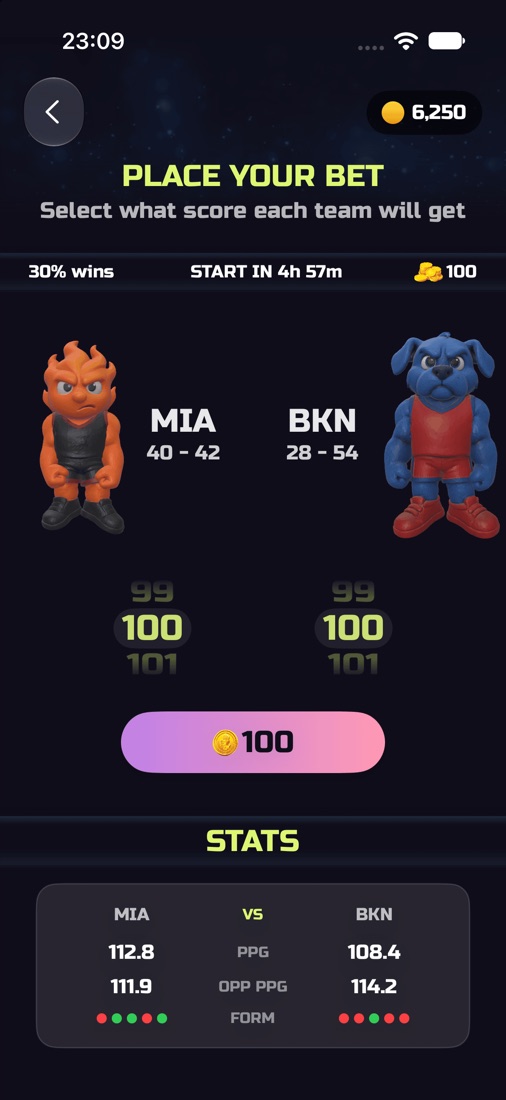
Step 2: adjust for the matchup
- Pace: two fast teams push the total up; two slow, defensive teams pull it down.
- Injuries and rest: a missing star or the second night of a back-to-back usually costs points.
- Home court: home teams tend to do a little better. Give them a small edge, not a big one.
- Recent form: the last five games say more about a team right now than its season average.
Step 3: pick the margin, then sanity-check the total
Decide who wins and by how much. Most regular-season games are not decided by huge margins, so be careful with blowout calls. Then add both scores: if your total is far above or below what these two teams usually produce, adjust. The combined score is what fans call the over/under: NBA over/under explained.
A worked example
Say the home team averages 116 PPG and allows 112, and the away team averages 110 and allows 115.
- Home expected: (116 + 115) ÷ 2 = about 115.5
- Away expected: (110 + 112) ÷ 2 = 111
- Adjust: the away team is on a back-to-back, so trim 2: about 109
- Call: 116 – 109
A do-it-yourself NBA score predictor
An NBA score predictor is a formula that turns team numbers into an expected score. The method above is one you can run by hand in two minutes, and you can see every step, so you know why the number came out the way it did. Here it is as one table, with the same example.
| Step | Home team | Away team |
|---|---|---|
| Points per game (PPG) | 116 | 110 |
| Opponent's points allowed (OPP PPG) | 115 | 112 |
| Expected score: the average of the two | 115.5 | 111 |
| Adjustment (pace, injuries, rest, home court) | none | −2 (back-to-back) |
| Your predicted score | 116 | 109 |
Predicted total: 116 + 109 = 225, which sits in the usual range for an NBA game. No predictor, by hand or by computer, hits exact scores often, which is why a score game should reward being close.
Why being close matters more than being exact
Exact scores are rare. In BUL you are ranked by distance: the points your call is off on each team, added together. If the game ends 118–106, the call 116–109 is 2 + 3 = 5 points off, which can still put you in the winning group. A wild call of 130–95 would be 12 + 11 = 23 points off.
Common mistakes
- Calling your team's dream score instead of a realistic one.
- Ignoring injuries announced just before tip-off.
- Forgetting that overtime is not counted in BUL: calls are scored on the regulation score.
Try the method on tonight's game. Free on iOS and Android.
BUL is free on iOS and Android. Search for BUL – Live Sports Competition on the App Store or Google Play.
Frequently asked questions
How do you predict the final score of an NBA game?
Average each team's points per game with its opponent's points allowed to get an expected score for each side, then adjust for pace, injuries, rest and home court, and check that the total looks realistic.
Is there a free NBA score predictor?
The method on this page is one you can run by hand: average each team's points per game with the other team's points allowed, then adjust for the matchup. BUL is free and shows both numbers on the call screen, but it does not predict for you. You make the call, and the game ranks how close you were.
Does overtime count in BUL?
No. BUL scores calls on the regulation score, so a game that goes to overtime is settled on the score at the end of regulation.
How close do you need to be to win in BUL?
Calls are ranked by distance, the points off on each team added together. The closest group of calls shares the game's coin pot, so you can win without an exact score.