
Guide
NBA over/under explained, and how to play it for fun with no money
What the over/under (the total) means in an NBA game, what a typical total looks like, what pushes a game over or under, and three free ways to play it with friends.
Short answer: the over/under, also called the total, is one number for the combined points of both teams. You say whether the real total will finish over it or under it. If the number is 226.5 and the game ends 118-106, the total is 224, so the under was right. You do not need money to play: set a number in your group chat, or call the full final score in BUL, where your two numbers add up to your own total.
Sportsbooks use the over/under for money. This guide is about the number itself: how to read it, how to set one yourself, and how to turn it into a free game for the people you watch with.
How the over/under works
- One number, both teams. Add the two final scores together. Who wins does not matter.
- Over or under. You say the combined score will be higher or lower than the number.
- The half point. Totals are often set at a half point, like 226.5, so the result can never land exactly on the number.
- A whole number can tie. If the number is 226 and the game ends 116-110, nobody is right. Decide in advance what a tie means in your game.
| The number | Final score | Combined | Result |
|---|---|---|---|
| 226.5 | 118-106 | 224 | Under |
| 226.5 | 121-112 | 233 | Over |
| 226.5 | 114-113 | 227 | Over, by half a point |
| 226 | 116-110 | 226 | Tie |
What is a typical NBA over/under?
In recent seasons NBA teams have averaged roughly 110 to 115 points a game (league averages on Basketball Reference), so two average teams combine for a total somewhere in the 220s. A matchup of two fast, high-scoring teams can sit well above that, and two slow, defensive teams well below.
Other competitions play shorter games, so their totals are lower. An NBA game is 48 minutes. A men's college game and a EuroLeague game are both 40 minutes, and a college possession can also run longer, so a college total is usually far below an NBA one. If you follow more than one league, do not carry the NBA number in your head: start from what those two teams actually score. More on those leagues in the NCAA basketball prediction game and EuroLeague prediction game guides.
How to set your own number in two minutes
You can build a fair total from four numbers: each team's points per game (PPG) and each team's points allowed per game (OPP PPG).
- Home team's expected score: the average of its own PPG and the away team's OPP PPG.
- Away team's expected score: the average of its own PPG and the home team's OPP PPG.
- Add the two. That is your total.
- Round to the nearest half point so nobody ties.
Example: the home team averages 116 and allows 112, and the away team averages 110 and allows 115. Home expected: (116 + 115) ÷ 2 = 115.5. Away expected: (110 + 112) ÷ 2 = 111. Total: 226.5. The same method, taken one step further into a full score, is in how to predict an NBA final score.
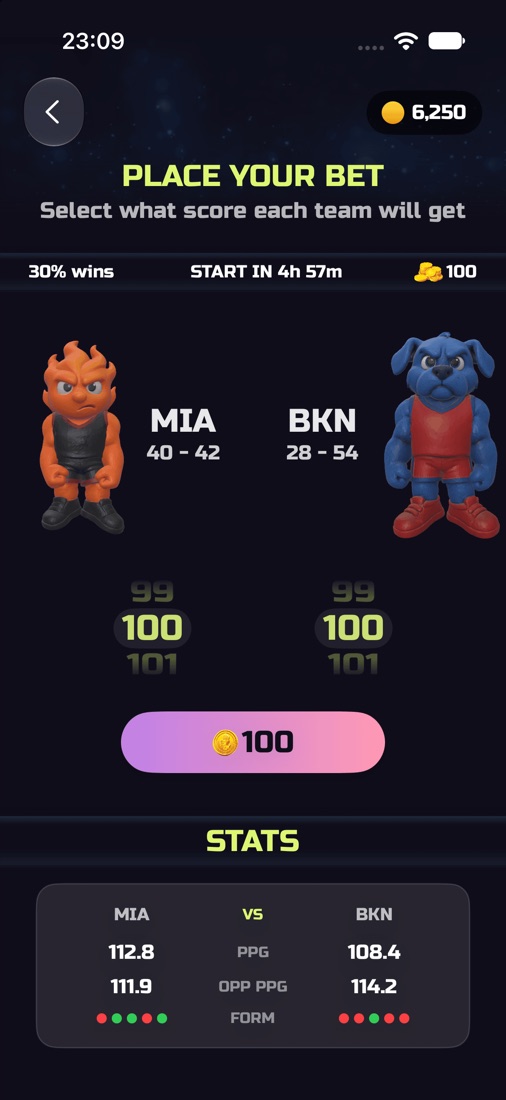
BUL shows PPG and OPP PPG for both teams on the call screen, next to each team's record and recent form.
What pushes a game over or under
- Pace. More possessions mean more shots. Two teams that run push the total up; two that walk the ball up pull it down.
- Three-point shooting. A hot or cold night from deep can move a total by 15 points on its own.
- Who is out. A missing scorer usually costs points. A missing defender can add them for the other side.
- Rest. Tired legs on the second night of a back-to-back tend to mean shorter shots and fewer points.
- A close finish. Intentional fouls and free throws in the last minute add points quickly.
- A blowout. When the starters sit, the fourth quarter can go either way: quick shots from the bench, or two teams running out the clock.
- Overtime. Five extra minutes add points. Agree before tip-off whether overtime counts in your game.
Three ways to play over/under for fun
1. Over or under in the group chat
One person posts the number before tip-off, using the method above. Everyone replies “over” or “under”. One point for being right. It takes ten seconds, and it gives the whole chat a reason to care about a garbage-time three.
2. Closest total
Skip the line. Everyone sends one number for the combined score, and the closest wins. This is better for small groups, because two people cannot both hide behind the same side.
3. Call the full score
The most complete version: call both teams' final scores. Your call holds a winner, a margin and a total at once. A call of 116-109 says the home team wins by 7 and the game finishes at 225. That is how BUL works. You set both scores with two spinners before tip-off, and during the game a live ladder groups everyone by how far their call is from the live score.
BUL does not have a separate over/under game. Its one question is the final score, and calls are ranked by how many points they are off on each team, added together. That means a good read on the total helps a lot: if you expect a slow, low-scoring night, calling both teams a few points lower keeps you close even when you get the winner wrong. The scoring is explained in how BUL scoring works.
It is free. A call costs 100 virtual coins, a free coin gift arrives every 3 hours, and coins have no cash value. BUL covers the NBA, NCAA basketball and the EuroLeague on iOS and Android.
BUL settles calls on the regulation score, so overtime is not counted. If your chat plays over/under by hand, the same rule is the simplest one to copy.
Keeping it a game
Played for points and bragging rights, over/under is a guessing game about basketball, like a trivia night. Nothing is staked and nothing can be won or lost except the argument. The longer answer is in is predicting sports scores gambling?, and more formats for the chat are in games to play in your NBA group chat. If you are here because you want the feeling without the money, read free alternatives to sports betting.
Call tonight's final score, total included. Free on iOS and Android.
BUL is free on iOS and Android. Search for BUL – Live Sports Competition on the App Store or Google Play.
Frequently asked questions
What does over/under mean in the NBA?
The over/under, or total, is one number for the combined points of both teams in a game. Over means the two final scores add up to more than the number, and under means they add up to less. Who wins the game does not matter.
What is a typical NBA over/under?
NBA teams have averaged roughly 110 to 115 points a game in recent seasons, so a typical total is in the 220s. Fast, high-scoring matchups sit higher and slow, defensive ones lower.
Why do totals end in .5?
A half point means the combined score can never land exactly on the number, so every game finishes either over or under and nobody ties.
Can you play over/under without money?
Yes. Post a number in your group chat and have everyone reply over or under for points, or have everyone guess the combined score. In BUL, a free game with virtual coins that have no cash value, you call the full final score, which includes your total.